


Whether you’re new to boating or a veteran captain, it’s important to learn the basic parts of a boat and related terminology. This blog post will cover the essential parts of a boat and what they do. We’ll also discuss some basic boat terms so you can feel confident talking to other boaters.
While different boats will have slightly different parts, the basics remain the same. The information below specifically focuses on boat parts and does not include details related to ships.
Read on for a simple breakdown of boat parts and terminology, including detailed information on how each part fits into the overall design of a vessel.
What Are the Different Areas or Sections of a Boat Called?
To start, we’ll focus on the areas and sections of a boat.
Aft: Describes the general location near the back end of a boat or toward the stern of a vessel.
Bow: The front end of the boat. The bow cuts through the water and provides a smooth ride for the boat and its occupants. The bow also helps deflect waves away from the boat, which can improve its stability and prevent rollover in rough conditions.
Forward: The area of the boat toward the front or bow.
Port: The left side of the boat.
Starboard: The right side of the boat.
Stern: The back end of a boat. The stern is where the engine is typically located.
What Are the Core Parts and Essential Structural Components of a Boat Called?
Beam: The beam of a boat is its width at its widest point. For most boats, this is at the midship section. The beam plays an important role in determining the stability and carrying capacity of the vessel. A wider beam means that the boat will be more stable, but it will also require more power to move through the water. Conversely, a narrower beam will make the boat easier to maneuver, but it will be less stable.
Bilge: The bilge is the lowest indoor space on a boat, where water and other liquids collect. The bilge pump removes water from the bilge and pumps it overboard.
Bulkhead: A bulkhead is a wall or partition that divides a hull into compartments. Bulkheads can also provide additional strength to the hull.
Cabin: A cabin is an enclosed space on a boat, typically located below deck, where people can sleep or take shelter from the weather. Cabins are usually equipped with basic furniture, such as beds, storage shelves, and a small table. In some cases, cabins may also have a private bathroom.
Casting Deck: A casting deck is a platform on a boat used for fishing. It is usually located at the front of the boat. The casting deck provides a stable surface for casting.
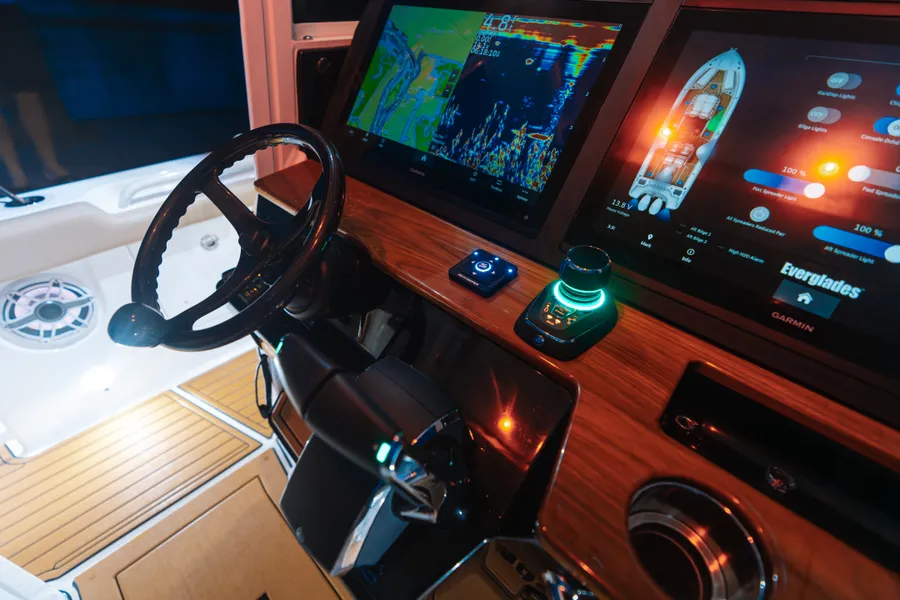
Cockpit: A boat’s cockpit is where the helmsman, or person steering the boat, stands. The cockpit is usually enclosed on larger boats, but it may be open on small boats. The cockpit is typically equipped with instrument panels and controls, as well as seating for the crew.
Console: A console is an area on a boat where the captain or helmsman stands while steering. The console usually houses the boat’s controls and instruments. In some cases, the console may also be equipped with seating, storage, or other features.
Deck: A deck is a flat surface area on a boat that typically provides space for passengers or cargo. Decks are located on the stern, bow, or midship of a vessel. Most decks are constructed from wood, fiberglass, or aluminum. Some deck features include chairs, fishing space, railings, and storage compartments.
Freeboard: The freeboard is the distance between the main deck and the waterline of a boat. The freeboard is important because it affects the stability of the vessel and how much weight it can carry. The freeboard also determines how much wind and wave action the boat will be exposed to.
Galley: A galley is a kitchen aboard a boat and is typically equipped with a stove, sink, and other basic amenities for food preparation.
Gunwale: The gunwale of a boat is the upper edge of the hull, typically where the sides meet the deck. It is also sometimes referred to as the trim or molding that runs along this edge. The gunwale serves several essential functions. First, it helps protect the boat from bumps and scrapes. Second, it provides an attachment point for various components, such as railings and cleats.
Head: A head is a room on a boat that contains a toilet and sink. It may also include a shower.
Helm: The helm of a boat is the location from which the captain or helmsman controls the vessel. The helm includes a steering wheel, throttle, and other control levers that allow the captain to navigate the boat. In some cases, the helm may also be equipped with navigational instruments, such as a compass or GPS.
Hull: The hull is the watertight body of a ship or boat. It is the structure that floats a vessel and gives it its shape.
Transom: The transom on a boat is the flat panel that forms the stern or back end. The transom provides both structural support and a place to mount the motor, steering system, and other hardware. In some cases, the transom also serves as a storage area or housing for the boat’s batteries in a battery compartment.
Waterline: The waterline is the line where the boat’s hull and the surface of the water meet.
Learn More with Sundance Marine
Whether you're shopping for your first boat or upgrading to your next adventure, our knowledgeable team is ready to answer your questions and help you explore the premium brands that fit the South Florida boating lifestyle. Visit Sundance Marine and let us help you make the most of every day on the water.